GENERAL LIABILITY INSURANCE:
DEFINITION, COVERAGE, BENEFITS, COST, CLAIMS
Why EverBright?
Best Price Guaranteed
Make a plan; we safeguard your assets with best-price assurance.
Zero stress - Total coverage
We provide end‑to‑end risk assessment, tailored policy placement and proactive claims support.
Tailored Solutions from Experts
Deliver tailored insurance solutions that protect your organisation’s unique exposures.
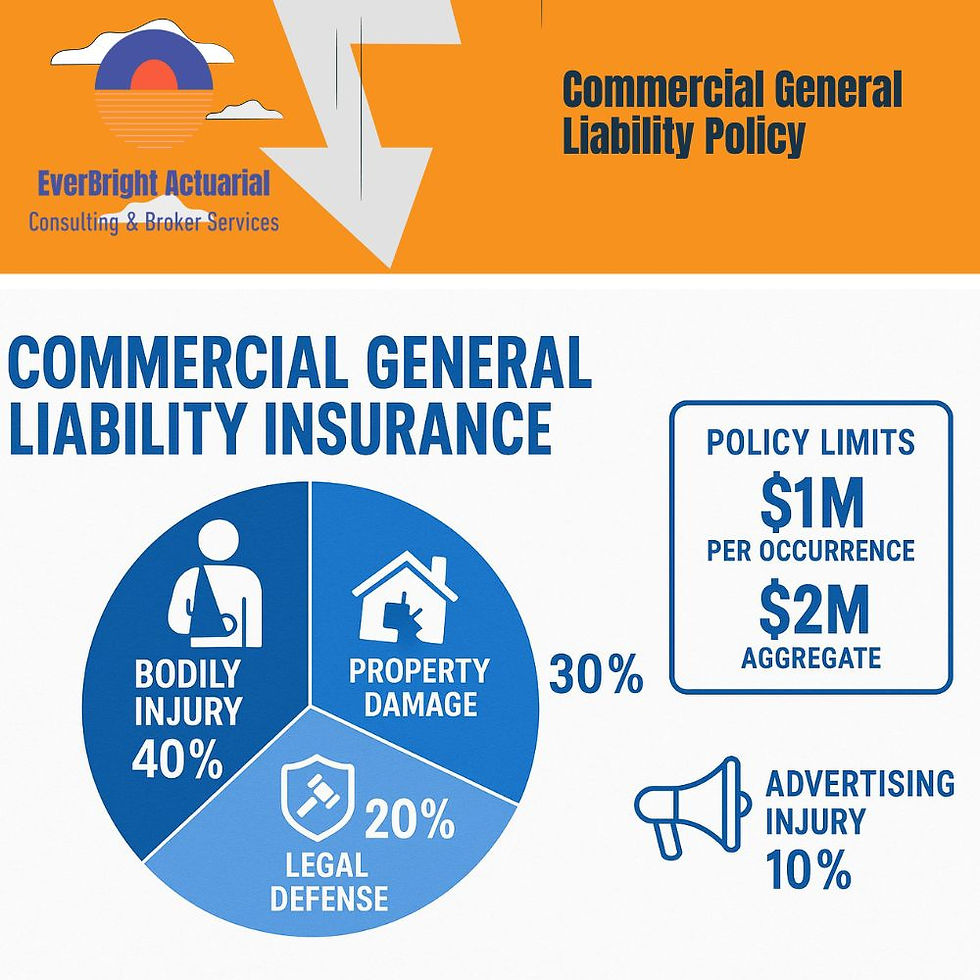
What is a Commercial General Liability Insurance Policy?
A Commercial General Liability (CGL) insurance policy protects a company against legal costs and compensatory damages that it becomes legally liable to pay for third‑party bodily injury or property damage.
Typical triggers include incidents arising from the company’s premises, its completed operations or its products. A CGL therefore combines public (third‑party) liability and product liability coverages, and is sometimes referred to as a Comprehensive General Liability policy.
What does a Commercial General Liability Insurance Policy Cover?
A Commercial General Liability (CGL) insurance policy, also known as general liability or business liability insurance, is a standard coverage designed to protect businesses from third-party claims related to their operations, premises, products, or services. It primarily safeguards against financial losses from lawsuits or claims involving bodily injury, property damage, or non-physical harms like reputational damage. This policy is essential for most businesses, as it covers legal defense costs, settlements, and judgments, but it does not protect against first-party losses (e.g., damage to your own property) or specific exclusions like professional errors or pollution.
CGL policies are typically structured into several key coverage parts, often referred to as Coverage A, B, and C in standard forms like those from the Insurance Services Office (ISO). Below is a breakdown of what is commonly covered, based on standard industry practices:
-
Coverage A: Bodily Injury and Property Damage LiabilityProtects against claims for physical harm to third parties or damage to their property caused by your business operations, premises, products, or completed work. This includes incidents on your business premises or arising from your activities. Coverage is triggered on an "occurrence" basis (during the policy period) or "claims-made" basis (when the claim is filed). Here are some examples of claims:
-
A customer slips on a wet floor in your store and sues for medical bills and lost wages.
-
Your construction crew damages a neighbor's fence while working on a site, leading to repair costs.
-
A product you sell malfunctions off-site, injuring the end-user.
-
-
Coverage B: Personal and Advertising Injury LiabilityCovers non-physical injuries related to defamation, privacy violations, or intellectual property issues stemming from your advertising, marketing, or business interactions. This does not include contractual disputes or employee injuries. Here are two examples of claims covered:
-
A competitor claims your ad campaign includes false statements that harmed their reputation (e.g., slander or libel).
-
A former client sues for invasion of privacy after you mistakenly used their image in promotional materials without permission.
-
-
Coverage C: Medical PaymentsProvides no-fault coverage for minor medical expenses of third parties injured on your premises or due to your operations, regardless of liability. It acts as a goodwill gesture to avoid larger lawsuits and has lower limits (e.g., $1,000–$5,000 per person). No legal defense is included here. Here are two examples of claims covered:
-
A delivery person twists an ankle on your warehouse steps; the policy covers their ambulance and ER visit without proving fault.
-
A visitor to your office cuts their hand on a sharp edge, covering stitches and follow-up care.
-
What are the exclusions under a Commercial General Liability Insurance Policy?
The Commercial General Liability Insurance Policy does not cover losses because of the following:
-
Bodily Injury or Property Damage occurring due to willful misconduct of the insured
-
Damages that the insured person becomes obligated to pay on account of Liability assumed in a contract
-
Exemplary or Punitive Damages
-
Expenses or Loss incurred on recall or disposal of product
-
Fines or Penalties
-
Multiplied Portion of any multiplied Damages
-
Bodily Injury or Property Damage arising out of actual or Alleged discharge of Pollutants
-
Damages or Loss arising out of the rendering of insured’s professional service or advice
-
Bodily Injury or Property Damage occurring on account of infringement or violation of any intellectual property laws or rights
-
Bodily Injury or Property Damage to the insured’s employee while performing duties related to the conduct of the insured person’s business
What are the Add-On Covers under a Commercial General Liability Insurance Policy?
The common Add-On Covers under a Commercial General Liability Policy are as follows:
-
Act of God Perils: This Extension Covers liability arising out of a natural catastrophe affecting the Insured Premises resulting in Bodily Injury and Property Damage of the Third Party
-
Food and Beverages Extension: The Food and Beverages Add-On Cover covers the legal liability arising out of injury/death of the third party which happens on account of consuming food or beverages on the Insured’s premises or after consuming such food products which are sold on the Insured’s premises
-
Swimming Pool, Beauty Clinic, Gyms Extension (and other similar facilities) under Commercial General Liability Policies covers legal liability arising out of bodily injury and property damage because of using such facilities inside the insured premises
-
Care, Custody and Control: This extension covers liability arising out of Bodily Injury and Property Damage to Third Party Goods which are handed over to the Insured for their custody and control.
-
Valet Parking Liability: This extension covers the liability arising out of damage to the vehicle while the valet parking personnel drives the vehicle.
-
72-Hours Sudden and Accidental Pollution Coverage: The CGL Policy covers sudden and accidental pollution which occurs within 72 hours and has caused damage that is certainly an accident. Note that the Insurance Policy does not cover Gradual Pollution.
-
Liquor Liability: Liquor Liability covers the liability that arises if the customer consumes liquor in a hotel/restaurant and causes Bodily Injury or Property Damage to Third Parties in an intoxicated state.
-
Incidental Medical Malpractice: This is another important add-on cover in a CGL Policy. Consider a case where a hotel guest falls sick and the hotel doctor treats the guest. However, something goes wrong with the doctor’s treatment because of which the guest suffers from illness or injury. The liability falls on the hotel and will be covered under the Incidental Medical Malpractices Extension of the CGL Policy. This Add-On Cover is more important for places like Malls, Hotels, Cinemas which will have guests.
-
Vicarious Liability covering Contractors, Subcontractors, Vendors, Suppliers, Agents etc.: This Extension covers the liability arising out of Bodily Injury and Property Damage to Third Parties on account of any action of the Contractors, Sub-Contractors, Vendors, Suppliers or Agents of the Insured Party.
-
Terrorism Legal Liability: This Add-On Cover covers the liability arising out of Bodily Injury and Property Damage to Third Parties on account of Terrorist Acts.
-
Transportation Extension: Earlier I had shown you the example of a blast resulting in damages. This extension covers liability arising out of bodily injury or damage occurring on account of the product being transported.
-
Lift and Escalator Liability: This extension covers the legal liability on account of Bodily Injury and Property Damage occurring in the lift and escalators of the building.
-
Non-Manual Visits of Employees Overseas: This extension covers the liability arising out of Third-Party Property Damage or Injury caused by the employee on account of his work when the employee goes overseas on a business tour.
-
Non owned and Hired Automobiles Liability: This Extension covers liability expenses for accidents caused by vehicles which are hired and not owned by a company for its work purposes
How much does a Commercial General Liability Insurance Cost?
The cost of Commercial General Liability (CGL) insurance, also known as general liability insurance, varies widely based on factors like your business size, industry, location, coverage limits, claims history, and the insurer.
Key Factors Influencing Costs
-
Industry Risk: High-exposure fields (e.g., construction) pay 5–10x more than low-risk ones (e.g., consulting).
-
Location: Urban areas like New York add 20–30% (e.g., $118/month) vs. rural spots like Maine ($88/month). In Hong Kong, dense operations may increase premiums.
-
Coverage Limits & Deductibles: $1M per occurrence is standard ($824/year average); higher limits raise costs 20–50%. Higher deductibles (e.g., $1,000–$5,000) can cut premiums by 10–25%.
-
Business Size/Revenue: More employees or $500K+ revenue bumps rates 15–30%.
-
Claims History: Clean records save 10–20%; prior claims increase by 25%+.
-
Insurer & Discounts: Bundling with property insurance (BOP) saves 10–20%; multi-policy or safety program discounts apply.
Tips to Lower Costs:
-
Bundle into a BOP for combined liability/property coverage.
-
Improve risk management (e.g., safety training) to qualify for lower rates.
-
Start with minimum required limits and adjust as your business grows.
What are the types of Commercial General Liability Insurance Policy?
Commercial General Liability (CGL) insurance policies are designed to protect businesses from third-party claims for bodily injury, property damage, and related liabilities arising from operations, premises, products, or services. While the core CGL form (often based on ISO standards) includes standard coverage sections, policies can vary by trigger type (how claims are activated), packaging options, and extensions for broader protection. Below is an overview of the main types, based on standard industry practices.
-
1. By Coverage Trigger: CGL policies differ primarily in when coverage applies—whether based on the timing of the incident or the claim filing.
-
Occurrence Policy: Coverage applies if the incident (e.g., injury or damage) occurs during the policy period, even if the claim is filed later. This is the most common type for CGL.
-
Claims-Made Policy: Coverage applies only if the claim is filed and reported during the policy period, regardless of when the incident occurred. Less common for standard CGL but used for certain risks.
-
-
2. By Packaging or Form: CGL can be issued standalone or bundled into broader policies for convenience and cost savings.
-
Standalone CGL Policy: A dedicated policy focusing solely on general liability risks. This type of CGL policy is customizable for high-risk businesses (e.g., contractors); it allows specific endorsements like product liability extensions.
-
Business Owners Policy (BOP): A bundled package including CGL, property insurance, and business interruption coverage, tailored for small to medium businesses.
-
Commercial Package Policy (CPP): A modular package combining CGL with other commercial coverages like property, crime, or inland marine. This type of CGL policy is flexible for larger or multi-risk businesses and allows mixing endorsements (e.g., adding cyber liability).
-
-
3. By Coverage Extensions (Endorsements): Standard CGL (with Coverages A, B, and C) can be enhanced with endorsements for specific risks, effectively creating customized "types." Common ones include:
-
Products-Completed Operations Coverage: Extends to off-premises incidents after work is done (e.g., a faulty product injuring a user post-sale).
-
Excess/Umbrella Liability: Sits above CGL limits for higher payouts (e.g., $5M+ coverage for catastrophic claims).
-
Liquor Liability: For businesses serving alcohol, covering intoxication-related injuries (excluded in standard CGL).
-
What are the various limits of liability in a Commercial General Liability Insurance Policy?
-
General Aggregate Limit: General Aggregate Limit in a CGL Policy is the maximum amount that the Insurance Company will pay in case of a CGL Claim.
-
Premises and Operations Limit: Premises and Operations Limit in a CGL Policy specifies the amount that the Insurance Company will pay in case of a claim alleging Bodily Injury or Property Damage within the Insured’s Business Premises or because of the Insured’s Operations.
-
Products and Completed Operations Limit: Products and Completed Operations Limit in a CGL Policy specifies the amount that the Insurance Company will pay in case of a claim alleging Bodily Injury or Property Damage because of using the Insured’s Products or because of the Insured’s Completed Work.
-
Personal and Advertising Injury Limit: Personal and Advertising Injury Limit in a CGL Policy specifies the amount that the Insurance Company will pay in case of a claim alleging Personal Injury or Advertising Injury such as Libel, Slander, Breach of Privacy etc.
-
Medical Expenses Limit: The Medical Expenses Limit pays the Medical Bills for small injuries/first aid for Bodily Injury to the Injured Party irrespective of the fault of the Insured Party. The limit applies to each person separately and does not have a deductible.
-
Damages in Premises Rented to You Limit: A Commercial General Liability Insurance Policy provides a reduced limit for Damage to the Premise rented to the Insured. A CGL Policy excludes coverage for damage to property owned, rented or occupied by the Insured and only provides coverage for Third-Party Property Damage. However, this exclusion is carved back by providing coverage for Damage to Premises rented to the Insured.
Key Components of a Commercial General Liability Insurance Policy
A Commercial General Liability (CGL) insurance policy is a foundational business product that protects an organisation against third‑party claims for bodily injury, property damage and related liabilities arising from its operations, premises, products or services. Most CGLs follow a standard form and are organised around core coverages, policy structure elements, limits and exclusions that define what is and is not insured.
-
Coverage A (Bodily Injury and Property Damage Liability) provides the primary protection for claims that someone is physically hurt or their property is damaged because of your business activities, completed operations or products. This coverage typically responds to occurrences that take place during the policy period and includes defence costs and settlements up to the policy limits. Intentional acts and expected damage are commonly excluded.
-
Coverage B (Personal and Advertising Injury Liability) addresses non‑physical harms such as libel, slander, false advertising or privacy violations arising from your marketing or business communications. It covers claims like defamation or unauthorised use of likeness, but usually excludes contractual disputes and employment‑related matters.
-
Coverage C (Medical Payments) is a no‑fault provision for minor medical expenses of third parties injured on your premises or by your operations. Limits are typically modest per person and this coverage is designed to pay immediate costs (ambulance, ER) and sometimes reduce the likelihood of litigation; defence costs are generally not included under this section.
-
The policy declarations page sets out key details—named insured, policy period, territory, premium and any additional insureds. The insuring agreement defines the insurer’s promise to pay, outlines the scope of coverages A, B and C, and specifies the duty to defend. It also clarifies “who is an insured” (for example, employees acting in the course of employment) and may list supplementary payments such as bail bonds or post‑judgment interest.
-
Conditions impose standard obligations on the insured and insurer, including prompt notice of claims, cooperation during investigations, premium payment terms and cancellation procedures. Exclusions carve out risks the CGL does not cover—common examples are professional liability (errors in professional services), pollution (often excluded unless endorsed), workers’ compensation, auto liabilities, intentional acts, product recalls and employment practices liabilities.
-
Limits of insurance describe maximum payouts: per‑occurrence limits, aggregate limits and any deductibles or self‑insured retentions.
-
Endorsements and riders allow customization to address specific exposures—examples include products‑completed operations extensions, liquor liability, hired/non‑owned auto coverage, or pollution and cyber endorsements where available. Policy form (occurrence vs. claims‑made), insurer practices and jurisdictional differences (for instance local naming conventions like “public liability” in Hong Kong) affect coverage details, so it’s important to review the declarations and specific wording and consult a broker to tailor the policy to your business needs.
What is the Claims Process for a Commercial General Liability Insurance Policy?
The Insured needs to follow the below mentioned steps to file a Claim under a Commercial General Liability Insurance Policy:
-
Step 1: Intimate the Claim to the Insurance Company as soon as possible
-
Step 2: Submit the necessary details such as Policy Number, Date and Time of Accident, Description of the Accident, legal notice received etc.
-
Step 3: Submit the documents required for a Commercial General Liability Insurance Claim such as ID Proofs, GST Certificate, Claim Form, Legal Notice etc.
-
Step 4: The Insurance Company appoints a surveyor to examine the facts of the incident.
-
Step 5: If the claim is admissible, the Insurance Company has a Duty to Defend the Insured against the lawsuit by providing an advocate to defend
What are the Benefits of a Comprehensive General Liability Insurance Policy?
A CGL Insurance Policy offers the following benefits:
-
Coverage against Bodily Injury and Property Damage Claims: Accidents are common and if an Injured Party sues the Company for Bodily Injury or Property Damage, the Company might have to pay Crores of Rupees in damages. This might put financial strain on the company.
-
Coverage against Personal and Advertising Injury: An additional Coverage offered under a CGL Policy is that of Personal and Advertising Injury. For example, if the Insured Company gets sued for Copyright Infringement in an Advertisement, such a claim would be covered by a Comprehensive General Liability Insurance.
-
Peace of Mind: A CGL Policy offers Peace of Mind since the Insured is secure in the knowledge that the business is protected against various claims which are increasingly common in everyday scenarios.
Who needs to purchase a Comprehensive General Liability Insurance Policy?
Every business, whether small or large, should purchase a Commercial General Liability Insurance Policy to protect itself against claims of Bodily Injury or Property Damage on the Insured Company’s business premises or on account of using the Insured Company’s Products. A Commercial General Liability Insurance Policy is a must for following Businesses:
-
Schools
-
Hotels
-
Cinemas
-
Malls
-
Pharmaceutical Manufacturers
-
Auto Component Manufacturers
Examples of Claims covered by a Commercial General Liability Insurance Policy
A Commercial General Liability Insurance Policy provides coverage for a wide range of claims faced by businesses when they are conducting their normal business operations. Some examples of Commercial General Liability Insurance Claims covered by the CGL Policy are as follows:
-
Slip and Fall Accidents: If a customer trips and falls on your business premises and sustains injuries as a result, the customer might sue the business owner. A CGL Policy will provide coverage for Defence Costs and Compensatory Damages in such a case. Such claims are common for restaurants, hotels and malls.
-
Product Liability Claims: If a product manufactured or sold by the company is defective and causes Injury or Illness to the Consumer, the Consumer might sue the Company. A Commercial General Liability Insurance provides coverage for such claims.
-
Advertising Injury Claims: A Commercial General Liability Insurance Policy also covers claims alleging Libel, Slander, Copyright Infringement arising while advertising the Insured Company’s products. Thus, a CGL Policy provides coverage against a wide range of claims likely to be faced by businesses in everyday situations.
Do Small Businesses Need Commercial General Liability Insurance?
Yes, small businesses typically need Commercial General Liability (CGL) insurance—or general liability insurance as it's commonly called—to protect against common risks like lawsuits from customers, property damage, or injuries. While it's not legally required in most places, it's often essential for contracts, leases, or loans, and it's widely recommended to avoid financial ruin from even minor claims.
CGL covers third-party claims arising from your operations, such as bodily injury (e.g., a customer slipping in your store), property damage (e.g., your employee accidentally breaking a client's equipment), or non-physical harms like advertising injury (e.g., a competitor suing over false claims in your ads). It also pays for legal defense, even if the claim is baseless. The following are serveral common reasons:
-
Contractual Requirements: Many clients, landlords, or lenders require proof of coverage (e.g., a certificate of insurance) before signing deals.
-
Risk Protection: Shields personal and business assets from lawsuits, which can bankrupt a small operation.
-
Industry Standards: Essential for customer-facing or hands-on businesses; most owners buy it early on.
-
Peace of Mind: Covers medical payments without fault and extends to employees acting on your behalf.
When might commercial general liability insurance not be strictly necessary?
It may be less essential for sole proprietors with no in‑person client contact or very low‑risk home‑based online businesses, though even remote work can produce claims (e.g., from advertising or emails). Mandatory requirements are uncommon and usually limited to high‑risk sectors, so skipping cover is optional but increases financial risk.
-
Sole Proprietors with No Public Interaction: If you work remotely with no clients on-site (e.g., a freelance writer), risks are lower—but even then, a bad ad or email could trigger a claim.
-
Low-Risk Home-Based Businesses: Pure online services might skip it initially, but bundling into a Business Owner's Policy (BOP) is often cheaper and adds property coverage.
-
Legal Exceptions: Only a few states mandate it for high-risk fields; otherwise, it's optional but risky to forgo.
Your Needs, Our Services
We offer free consultations. If you want to learn more, please contact us at info@ebactuary.com or 📞+852 3563 8440. You can also fill out our Contact Form, and we guarantee to get back to you within 24 hours.
Liability Insurance
engineering insurance
Machinery Breakdown
Boiler Pressure Plant
Electronic Equipment
Advance Loss of Profit
Factory and Warehouse
Machinery Loss of Profit
property insurance
Electronic Equipment
Business Interruption
Burglary Insurance
group insurance
Group Travel Insurance
Group Disability Insurance
Supplementary Group Medical
Trade Credit
Student Group Insurance
Marine & Pecuniary
Marine Cargo Insurance
Marine Open Policy
Protection & Indemnity, P&I
Hull & Machinery Insurance
Inland & Warehouse
Motor Insurance
Fine Art & Jewellers
Trade Credit
Individual Line
Health Insurance
Critical Illness
Home & Contents
Life & Private Medical
Inland & Warehouse
Motor Insurance