PROPERTY ALL RISK INSURANCE:
DEFINITION, COVERAGE, BENEFITS, COST, CLAIMS
Why EverBright?
Best Price Guaranteed
Make a plan; we safeguard your assets with best-price assurance.
Zero stress - Total coverage
We provide end‑to‑end risk assessment, tailored policy placement and proactive claims support.
Tailored Solutions from Experts
Deliver tailored insurance solutions that protect your organisation’s unique exposures.
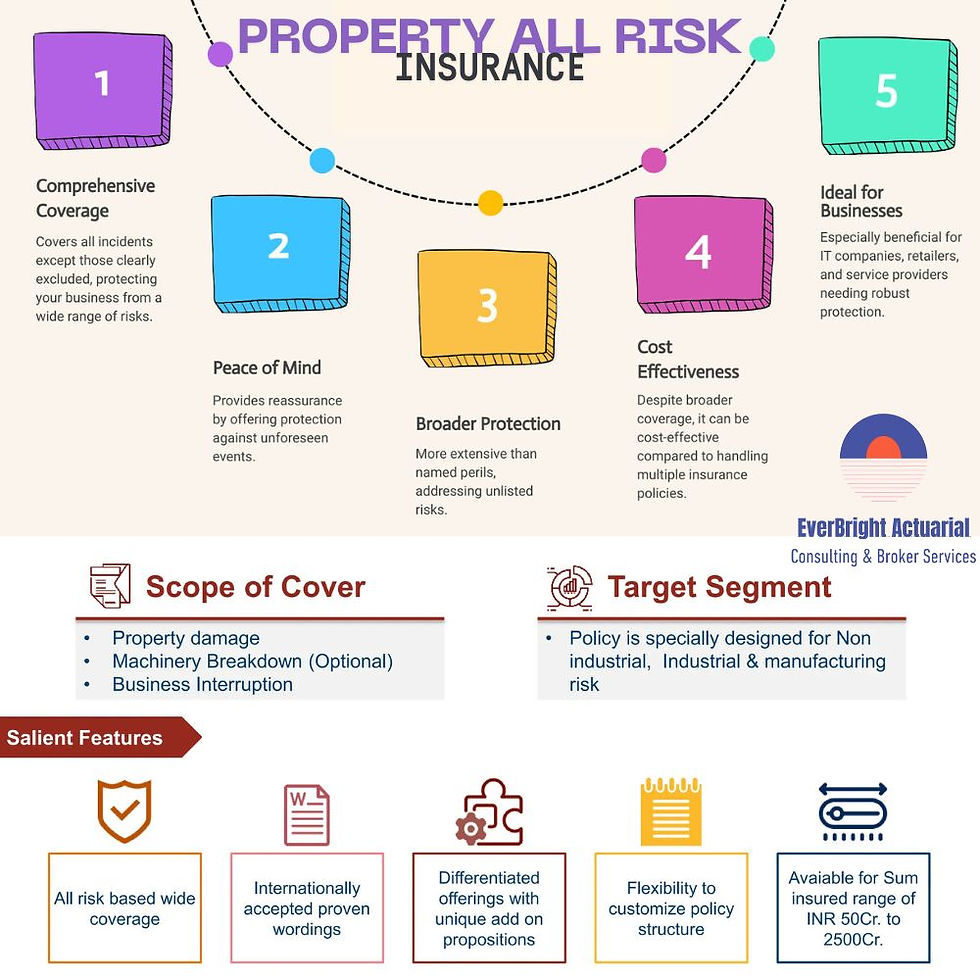
What is Property All Risk Insurance and when to choose it?
Property All Risk (PAR) Insurance is a broad-form property policy that covers physical loss or damage to insured property from all causes except those specifically excluded in the policy. Key features:
-
Broad coverage: Insures against accidental or unforeseen perils unless expressly excluded (contrast: named-peril policies only cover listed causes like fire, theft, wind).
-
First-party focus: Pays the insured for repair, replacement, or indemnity of covered property.
-
Flexible valuation: Can be written on replacement cost, actual cash value, agreed value, or indemnity basis.
-
Common exclusions: War, nuclear hazard, intentional acts, wear and tear/gradual deterioration, some types of water damage, latent defects, and certain pollution or professional liability exposures.
-
Endorsements/clauses: Theft, flood, earthquake, machinery breakdown, business interruption, ordinance or law, and limits/deductibles are often added or modified by endorsement.
When to choose PAR:
-
Valuable, diverse, or complex property portfolios where broad protection is desired.
-
Commercial or industrial operations where causes of loss may be varied or hard to identify.
-
When peace of mind and simpler claims burden outweigh higher premium.
how does par differ from standard property insurance?
How it differs from standard (named-peril) property insurance:
-
Scope: PAR covers all perils except exclusions; standard named-peril covers only specified perils.
-
Risk assumption: PAR shifts broader risk to insurer, usually at higher premium and with more detailed policy wording.
-
Claims burden: Under PAR the insured need only show loss occurred and was not excluded; under named-peril the insured must prove loss was caused by a covered peril.
-
Customization: PAR is often more customizable with endorsements for high-value or specialty exposures (e.g., fine art, industrial machinery).
What types of properties are typically covered under a Property All Risk Insurance policy?
Typical properties covered under Property All Risk insurance:
-
Commercial buildings (offices, retail, warehouses)
-
Residential buildings (homes, apartment blocks)
-
Industrial facilities (factories, plants)
-
Business contents (furniture, stock, office equipment)
-
Machinery and plant (industrial machines, production equipment)
-
Electronic equipment (servers, computers, telecom gear)
-
Tenant improvements and leasehold interests
-
Inventory and raw materials
-
Contractors’ plant and equipment (on-site tools, temporary structures)
-
Transit goods (inland transit, depending on wording)
-
Specialized assets (fine art, jewellery, if scheduled)
Coverage depends on policy wording and endorsements; high-value or specialized items often require specific schedules or limits.
What are the key perils covered by a Property All Risk Insurance policy?
Property All Risk Insurance, also known as "all risks" or "comprehensive" property insurance, typically covers a broad range of perils unless specifically excluded in the policy. The key perils covered generally include:
-
Fire and Explosion: Damage caused by fire, lightning, or explosions (e.g., gas leaks or chemical reactions).
-
Natural Disasters: Events like storms, hurricanes, tornadoes, hail, and sometimes floods or earthquakes (if not excluded or added via endorsement).
-
Theft and Vandalism: Loss or damage due to theft, burglary, or malicious acts.
-
Water Damage: Incidents like burst pipes, leaks, or sprinkler system malfunctions (excluding floods unless specified).
-
Impact Damage: Damage from vehicles, aircraft, or falling objects (e.g., trees or debris).
-
Accidental Damage: Unforeseen and unintended damage, such as dropping equipment or structural mishaps.
-
Riots and Civil Commotion: Damage caused by riots, strikes, or public disturbances.
-
Collapse: Structural collapse due to covered perils like weight of snow, ice, or other forces (if not excluded).
Unlike named-perils policies, Property All Risk Insurance covers all causes of loss except those explicitly excluded, such as wear and tear, war, nuclear hazards, or intentional damage. Coverage specifics vary by policy, so it’s critical to review the terms and exclusions with the insurer.
What types of losses are excluded under a typical Property All Risk Insurance policy?
Under a typical Property All Risk Insurance policy, coverage is broad, encompassing most causes of loss unless explicitly excluded. Below is a list of common losses typically excluded under such policies, though specific exclusions may vary depending on the insurer, policy wording, and jurisdiction:
-
Wear and Tear or Gradual Deterioration: Damage due to normal aging, rust, corrosion, mold, or gradual deterioration over time is generally not covered.
-
War and Military Action: Losses caused by war, civil war, rebellion, insurrection, or military action are typically excluded.
-
Nuclear Hazard: Damage from nuclear reactions, radiation, or radioactive contamination is almost universally excluded.
-
Intentional Damage: Losses caused deliberately by the insured or someone acting on their behalf are not covered.
-
Government Action: Seizure, destruction, or confiscation of property by government authorities is typically excluded.
-
Terrorism: Damage caused by acts of terrorism may be excluded unless explicitly included through an endorsement or separate policy.
-
Pollution and Contamination: Losses due to pollution, chemical spills, or contamination are typically excluded unless caused by a covered peril (e.g., a fire leading to chemical release).
-
Mechanical or Electrical Breakdown: Failures of machinery, electrical systems, or equipment due to internal defects or breakdowns are often not covered.
-
Inherent Vice: Damage caused by a property’s inherent defects or tendencies (e.g., materials prone to cracking or rotting) is excluded.
-
Fraud or Deceit: Losses resulting from fraudulent acts, misrepresentation, or concealment by the insured are not covered.
-
Vacancy or Unoccupancy: Damage to a property left vacant or unoccupied for an extended period (e.g., 30–60 days, depending on the policy) may be excluded or limited.
-
Faulty Design or Workmanship: Damage due to poor construction, defective materials, or faulty design is often not covered.
-
Mould, mildew, rot, vermin, insects, bacterial or fungal action.
Are business interruption losses covered under Property All Risk Insurance?
Business interruption losses are not typically covered under a standard Property All Risk Insurance policy unless explicitly included as an additional coverage or endorsement. Here's a detailed explanation:
-
Standard Coverage: Property All Risk Insurance primarily covers physical damage to insured property (e.g., buildings, equipment, inventory) caused by covered perils (e.g., fire, theft, or storms). It focuses on tangible property losses rather than consequential losses like lost income or profits.
-
Business Interruption Coverage: This type of coverage, also known as business income coverage, compensates for lost revenue, operating expenses, or additional costs incurred when a business cannot operate due to a covered peril damaging the insured property. For example, if a fire damages a factory and halts production, business interruption coverage could cover lost profits and ongoing expenses like rent or payroll during the downtime.
-
Inclusion in All Risk Policies:
-
Business interruption coverage is often offered as an optional endorsement or extension to a Property All Risk Insurance policy. It is not automatically included in the base policy.
-
When included, it typically requires that the interruption results from a covered peril (e.g., fire or storm) that causes physical damage to the insured property.
-
The policy may specify a waiting period (e.g., 48–72 hours) before coverage begins and may have limits on the duration of coverage (e.g., 12 months) or the amount payable.
-
What documentation is required to obtain a Property All Risk Insurance policy?
Typical documentation required to obtain Property All Risk insurance:
-
Completed proposal form / insurance application
-
Proof of identity for applicant(s) (ID card, passport)
-
Proof of ownership or interest in the property (title deed, lease agreement, sale contract)
-
Property address and legal description
-
Recent property valuation or professional valuation report (if required)
-
Building construction details (year built, construction type, number of floors, roof type)
-
Site plans, floor plans, and layout drawings (especially for commercial/industrial)
-
Details of occupancy and use (business type, residential, mixed-use)
-
List/schedule of insured contents, equipment and values (inventory list, serial numbers for high-value items)
-
Photographs of the property and significant assets (interior and exterior)
-
Details of fire protection and security measures (alarms, sprinklers, extinguishers, locks, CCTV)
-
Maintenance records and inspection reports for key equipment (HVAC, boilers, lifts, machinery)
-
Previous insurance history and claims record (loss runs)
-
Financial information for businesses (latest financial statements, turnover)
-
Construction/renovation permits and contractor details (if recently built or under renovation)
-
Any specialist reports if relevant (structural engineer, asbestos survey, electrical inspection)
Insurers may request additional documents depending on property type, location, risk profile, and local regulatory requirements.
What is the typical duration of a Property All Risk Insurance policy?
The typical duration of a Property All Risk Insurance policy is one year (12 months). Most insurers issue these policies on an annual basis, with the option to renew at the end of the term. However, the duration can vary depending on the insurer, the insured’s needs, and specific circumstances. Below are key points about policy duration:
-
Standard Term: A 12-month policy term is the most common, starting from the effective date specified in the policy and ending at midnight on the expiration date.
-
Short-Term Policies: In some cases, shorter durations (e.g., 3, 6, or 9 months) may be available for specific situations, such as temporary projects, leased properties, or seasonal businesses. These are less common and may have higher premiums relative to the term.
-
Long-Term Policies: Some insurers offer multi-year policies (e.g., 2–3 years), particularly for stable commercial properties, but these are rare and may include clauses allowing premium adjustments based on risk changes.
-
Renewal Process: At the end of the policy term, the policy can typically be renewed, subject to updated risk assessments, premium adjustments, and any changes in policy terms or exclusions.
-
Cancellation Clauses: Policies often include provisions allowing either the insured or insurer to cancel before the term ends, with notice periods (e.g., 30 days) and conditions outlined in the policy.
-
Project-Specific Policies: For construction or renovation projects, policies may be tailored to the project duration, often covering the construction period plus a short maintenance period.
Notes:
-
The duration is specified in the policy document, and it’s critical to review this to ensure continuous coverage.
-
Premiums are typically paid annually, but some insurers offer installment plans (e.g., monthly or quarterly) for annual policies.
-
For policies tied to leased properties, the duration may align with the lease term, especially for tenants.
How is the Property All Risk insurance premium calculated and what factors affect its cost?
Property All Risk (PAR) premiums are calculated by assessing the insured exposure (sum insured) and applying a base rate adjusted for risk loadings, discounts and endorsements.
Basic conceptual formula: Premium = Sum Insured × Base Rate × Adjustment Factors − Discounts
Key factors that affect cost:
-
Sum insured and valuation method (replacement cost vs. actual cash value)
-
Property type and construction (masonry vs. timber, roof type, fire resistance)
-
Occupancy and use (residential, commercial, industrial, hazardous operations)
-
Location and site risk (crime, flood/earthquake zones, proximity to fire brigade)
-
Fire protection and security measures (sprinklers, alarms, extinguishers, CCTV, guards)
-
Age, condition and maintenance of building and equipment
-
Contents and equipment values, concentration of high-value items (servers, machinery, stock)
-
Claims history / loss record of the property or insured
-
Deductible/excess level and any co-insurance clauses (higher deductible lowers premium)
-
Coverage scope and extensions (accidental damage, flood, earthquake, machinery breakdown, transit, terrorism, BI)
-
Policy limits, sub-limits and aggregate limits for certain items
-
Business interruption exposure if included (turnover, indemnity period)
-
Exposure period, occupancy stability and vacancy risk
-
Underwriter’s appetite, reinsurance costs and current market conditions
-
Regulatory charges, taxes and statutory levies
Underwriters combine these into a final rate using loadings/discounts and may require risk surveys or endorsements which can further adjust premium. Contact EverBright for the most competitive quote!
How to decide the Sum Insured of the property all risk Policy?
To decide the Sum Insured for a Property All Risk policy, follow these steps:
-
Identify insured items: List buildings, fixtures, tenant improvements, contents, stock, machinery, electronic equipment, and any specialty items (art, servers, plant).
-
Choose valuation basis for each item
-
Replacement cost (rebuild/replace like-for-like, excluding depreciation) — common for buildings/equipment.
-
Reinstatement/contractor’s reinstatement (includes demolition/site clearance/underground services).
-
New for old (full replacement for like-new items).
-
Actual cash value (replacement minus depreciation) — lower premium but higher out-of-pocket risk.
-
Agreed value (pre-agreed sum for hard-to-value items).
-
-
Calculate accurate values
-
Buildings: obtain current rebuilding cost per m² × area, include demolition, foundation, professional fees, permits, and local rebuilding inflation.
-
Plant & machinery / equipment: current replacement cost including installation and freight.
-
Stock/inventory: use peak stock levels (seasonal highs) or average plus buffer; include raw materials and finished goods.
-
Contents/furniture/fixtures: current replacement cost.
-
Electronic equipment: include spare parts, software reinstallation and data restoration costs if applicable.
-
Business interruption (if insured): calculate gross profit/turnover and required indemnity period to derive sum insured.
-
-
Add ancillary costs: Debris removal, professional fees (architect/engineer), increased cost of working, ordinance-of-law/upgrading costs if rebuilding to new code (if desired).
-
Apply contingency and inflation margins: Add a margin (commonly 10–20%) for price inflation, unexpected increases, or underestimation; consider local construction inflation rates.
-
Consider coinsurance/average clauses: Avoid being underinsured: if policy has a coinsurance clause, ensure declared sum insured meets required percentage (e.g., 80–100% of full value) to prevent proportionate claim penalty.
-
Review special items separately: Schedule high-value or unique items with agreed values to avoid sub-limits or averaging.
-
Reassess regularly: Update sums insured annually or after renovations, major purchases, stock level changes, or material cost changes.
Contact EverBright for the best calculation of your PAR sum insured.
How does the claims process work for Property All Risk Insurance?
The claims process for a Property All Risk Insurance policy involves several steps to report, assess, and settle a claim for a covered loss. While the exact process may vary depending on the insurer, policy terms, and jurisdiction, the following outlines the typical steps:
-
Immediate Notification:
-
Contact the Insurer and Provide Initial Details
-
-
Mitigate Further Damage:
-
Take reasonable steps to prevent additional damage to the property. Keep receipts for any emergency repairs or expenses, as these may be reimbursable under the policy.
-
-
Submit a Formal Claim:
-
Complete a Claim Form with Supporting Documentation (i.e. evidence to support the claim).
-
-
Insurer’s Assessment:
-
Loss Adjuster Appointment: The insurer assigns a loss adjuster (or claims adjuster) to investigate the claim. The adjuster evaluates the damage, verifies coverage, and estimates the cost of repairs or replacement.
-
Site Inspection: The adjuster may visit the property to assess the damage in person, review the cause of loss, and confirm it’s a covered peril under the policy.
-
-
Claim Review and Coverage Determination:
-
The insurer reviews the adjuster’s report, policy terms, and submitted documentation to determine if the loss is covered under the “all risk” policy (i.e., not excluded).
-
The insurer confirms whether the claim falls within policy limits, sub-limits (e.g., for high-value items), or deductibles.
-
-
Settlement Offer:
-
Valuation: The insurer calculates the settlement based on the policy’s valuation method (e.g., replacement cost, actual cash value, or agreed value for scheduled items).
-
Offer: The insurer provides a settlement offer, which may include funds for repairs, replacement, or reimbursement of expenses (e.g., temporary relocation costs if covered).
-
Negotiation: If you disagree with the offer, you can negotiate with the insurer, providing additional evidence or professional estimates to support your claim.
-
-
Payment or Repair:
-
Once the claim is approved, the insurer issues payment, typically after applying the deductible. Payment may be made in stages (e.g., partial payment for immediate repairs, final payment after completion). For some claims, the insurer may arrange for repairs directly through approved contractors.
-
-
Finalization:
-
The claim is closed once repairs are completed, replacements are made, or the settlement is fully paid.
-
Keep records of all claim-related communications and payments for future reference.
-
Contact EverBright for assistance with your claim!
What is the role of a loss adjuster in the claims process for this insurance?
A loss adjuster plays a critical role in the claims process for a Property All Risk Insurance policy, acting as an intermediary between the policyholder and the insurer to assess and evaluate a claim. Their primary function is to investigate the loss, verify coverage, and determine the appropriate compensation in accordance with the policy terms. Below is a detailed explanation of the loss adjuster’s role in the claims process:
-
Initial Assessment:
-
Claim Review: Upon receiving a claim, the insurer assigns a loss adjuster who reviews the initial claim details provided by the policyholder, including the claim form, incident description, and any preliminary documentation (e.g., photos, police reports).
-
Policy Analysis: The adjuster examines the Property All Risk Insurance policy to confirm that the reported loss is caused by a covered peril (i.e., not excluded) and falls within the policy’s terms, limits, and conditions.
-
-
Investigation:
-
Site Inspection: The loss adjuster often visits the damaged property to inspect the extent of the loss, assess the cause, and document the damage through photographs, measurements, or notes.
-
Interviews: They may interview the policyholder, witnesses, or other relevant parties (e.g., contractors, neighbors) to gather additional details about the incident.
-
Evidence Collection: The adjuster collects and reviews supporting documentation, such as repair estimates, invoices, receipts, appraisals (for high-value items like artwork or jewelry), or inventory lists for damaged contents.
-
-
Damage Evaluation:
-
Quantifying the Loss: The adjuster estimates the cost of repairs, replacement, or restoration based on the policy’s valuation method (e.g., replacement cost, actual cash value, or agreed value for scheduled items).
-
Scope of Damage: They determine whether the damage is directly attributable to a covered peril and identify any excluded losses (e.g., wear and tear, flood damage if not covered).
-
Mitigation Efforts: The adjuster verifies that the policyholder has taken reasonable steps to mitigate further damage (e.g., securing the property or making temporary repairs), as required by most policies.
-
-
Coverage Verification:
-
The loss adjuster ensures the claim aligns with the policy’s coverage, checking for applicable sub-limits (e.g., for high-value items), deductibles, or endorsements (e.g., for business interruption or flood coverage).
-
They identify any exclusions that may apply, such as losses due to war, nuclear hazards, or intentional damage, and communicate these to the insurer.
-
-
Reporting and Recommendations:
-
Claims Report: The adjuster prepares a detailed report summarizing their findings, including the cause of loss, extent of damage, estimated repair or replacement costs, and whether the claim is covered under the policy.
-
Settlement Recommendation: Based on their assessment, the adjuster recommends a settlement amount to the insurer, which may include costs for repairs, replacements, or additional expenses (e.g., temporary relocation or business interruption, if covered).
-
-
Negotiation and Communication:
-
Liaison Role: The loss adjuster serves as a point of contact between the policyholder and the insurer, explaining the claims process, coverage decisions, and any issues (e.g., partial denials due to exclusions).
-
Negotiation: If the policyholder disputes the proposed settlement or provides additional evidence (e.g., higher repair estimates), the adjuster may negotiate to reach a fair resolution within policy limits.
-
-
Facilitating Settlement:: Once the insurer approves the claim based on the adjuster’s report, the loss adjuster ensures the settlement process moves forward, coordinating with the policyholder on payment or repair arrangements.
Types of Loss Adjusters:
-
Insurer-Employed Adjusters: Work directly for the insurance company and prioritize the insurer’s interests while ensuring a fair assessment.
-
Independent Adjusters: Hired by the insurer on a contract basis, often for large or complex claims, to provide an impartial evaluation.
-
Public Adjusters: Hired by the policyholder to represent their interests, advocate for a higher settlement, and navigate the claims process. Public adjusters are not typically involved unless the policyholder seeks external assistance.
How does reinstatement value differ from market value in Property All Risk Insurance?
Reinstatement value, also known as replacement cost, is the cost to repair, rebuild, or replace the damaged property to its pre-loss condition, using materials and methods of similar kind and quality, without deduction for depreciation. Market value is the amount the property could be sold for in the open market at the time of the loss, taking into account factors like location, demand, condition, and depreciation. Key Differences:
-
Basis
-
Reinstatement Value: Cost to rebuild or replace to pre-loss condition
-
Market Value: Current selling price in the open market
-
-
Depreciation
-
Reinstatement Value: Not deducted (focus on new construction)
-
Market Value: Deducted (reflects age and condition)
-
-
Land Value
-
Reinstatement Value: Excludes land value
-
Market Value: Includes land value
-
-
Purpose
-
Reinstatement Value: Restore property to original state
-
Market Value: Compensate based on property’s economic worth
-
-
Payout Amount
-
Reinstatement Value: Typically higher (current construction costs)
-
Market Value: May be lower or higher (depends on market)
-
-
Premium Cost
-
Reinstatement Value: Higher premiums due to full replacement cost
-
Market Value: Lower premiums due to depreciation consideration
-
-
Common Use
-
Reinstatement Value: Preferred for buildings and critical assets
-
Market Value: Used for older properties or ACV-based policies
-
Application in Property All Risk Insurance
-
Reinstatement Value: Most Property All Risk Insurance policies for buildings are written on a reinstatement value basis to ensure the policyholder can fully rebuild after a covered loss (e.g., fire, storm). This is especially common for commercial properties or high-value assets where continuity is critical.
-
Market Value: Less common in All Risk policies, but may apply in specific cases, such as when insuring older properties, vacant buildings, or when the policyholder opts for actual cash value coverage to reduce premiums.
-
Policy Terms: The valuation method (reinstatement or market value) is specified in the policy’s terms and conditions. Some policies allow policyholders to choose, while others may combine both (e.g., reinstatement for buildings, market value for contents).
-
Scheduled Items: For high-value items like artwork or jewelry, policies may use an agreed value (a pre-determined amount) rather than reinstatement or market value, based on appraisals.
Contact EverBright for assistance with your claim!
What are the common Customized Add-Ons for Property All Risk Insurance ?
Property All Risk Insurance policies can often be customized to include additional coverages through endorsements, riders, or floaters, allowing policyholders to tailor the policy to their specific needs.
Since All Risk policies cover all perils except those explicitly excluded, additional coverages are typically used to address specific exclusions or extend protection for unique risks or assets.
How Customization Works
-
Endorsements/Riders: These are amendments to the standard policy that add, modify, or remove coverage terms. They allow policyholders to include perils or items not covered in the base policy.
-
Floaters: Often used for high-value or specialized items (e.g., jewelry, artwork), floaters provide specific coverage for individual assets, often with higher limits or fewer restrictions.
-
Negotiation with Insurer: Customization requires discussion with the insurer or broker to assess the risk, determine additional premiums, and ensure compliance with underwriting guidelines.
-
Premium Impact: Adding coverages typically increases the policy premium, depending on the risk
Common customized add-ons for Property All Risk Insurance include:
-
Flood and earthquake coverage
-
Machinery breakdown and equipment failure
-
Business interruption and rental income protection
-
Debris removal and extra expenses
-
Ordinance or law coverage for building code compliance
-
Spoilage coverage for perishable goods
-
Terrorism and sabotage protection
-
Data and electronic equipment coverage
-
Fine arts and high-value asset schedules
-
Transit and stock in transit coverage
-
Increased replacement cost or inflation protection
These add-ons are tailored based on property type, location, and specific risk exposures. Contact EverBright for expert risk assessment and tailored insurance solutions.
Are there specific maintenance requirements to keep a Property All Risk Insurance policy valid?
Yes, Property All Risk Insurance policies often include specific maintenance requirements that policyholders must follow to keep the policy valid and ensure claims are not denied.
While the exact requirements vary by insurer, policy, and property type (e.g., commercial vs. residential), the following outlines common maintenance obligations:
Common Maintenance Requirements:
-
General Upkeep and Repairs
-
Fire Safety Measures
-
Security Systems
-
Electrical and Mechanical Systems
-
Plumbing and Water Systems
-
Pest and Vermin Control
-
Compliance with Local Regulations:
-
Risk Mitigation for Specific Perils
-
Documentation and Reporting
Consequences of Non-Compliance
-
Claim Denials: If a loss occurs due to neglected maintenance (e.g., a fire caused by faulty wiring that wasn’t inspected), the insurer may deny the claim, citing failure to maintain the property.
-
Policy Cancellation: Repeated failure to meet maintenance requirements or disclose risks may lead to policy cancellation or non-renewal.
-
Reduced Payouts: Some policies apply penalties or reduced payouts if maintenance lapses contributed to the loss.
Your Needs, Our Services
We offer free consultations. If you want to learn more, please contact us at info@ebactuary.com or 📞+852 3563 8440. You can also fill out our Contact Form, and we guarantee to get back to you within 24 hours.
Liability Insurance
engineering insurance
Machinery Breakdown
Boiler Pressure Plant
Electronic Equipment
Advance Loss of Profit
Factory and Warehouse
Machinery Loss of Profit
property insurance
Electronic Equipment
Business Interruption
Burglary Insurance
group insurance
Group Travel Insurance
Group Disability Insurance
Supplementary Group Medical
Trade Credit
Student Group Insurance
Marine & Pecuniary
Marine Cargo Insurance
Marine Open Policy
Protection & Indemnity, P&I
Hull & Machinery Insurance
Inland & Warehouse
Motor Insurance
Fine Art & Jewellers
Trade Credit
Individual Line
Health Insurance
Critical Illness
Home & Contents
Life & Private Medical
Inland & Warehouse
Motor Insurance