Exporting to the U.S.: A Complete Guide to Product Liability Insurance and Regulatory Compliance (Latest Edition)
This guide is targeted at exporters from Hong Kong (or other regions) exporting various commodities to the United States, providing extremely detailed practical guidance. U.S. import regulations are dominated by the U.S. Customs and Border Protection (U.S. Customs and Border Protection, CBP) and involve multiple Partner Government Agencies (Partner Government Agencies, PGAs, such as FDA, USDA, EPA, CPSC, etc.).
The United States remains the market with the highest product liability litigation risk globally. Verdicts (verdicts >US$10M) and massive settlements continue to occur frequently in 2025–2026, making foreign exporters highly susceptible to being involved. Product liability insurance is not a mandatory requirement under U.S. law, but it is almost a “must-have condition” for entering the U.S. market — retailers such as Amazon, Walmart, Target usually require a minimum coverage of US$2M–10M in supplier contracts and list it as Additional Insured. Those without insurance are often rejected for import or have contracts canceled, and a single loss in litigation can lead to bankruptcy.
General Export to the U.S. Customs Procedures and Requirements
U.S. imports adopt the “Importer of Record” system (Importer of Record, IOR, usually the U.S. buyer or its designated broker). The exporter (Hong Kong side) must provide accurate documents, otherwise the goods may be detained, fined or returned.
Key Document Requirements (Applicable to All Goods)
Commercial Invoice: Must be in English, including seller/buyer details, complete goods description (sufficient for HTS classification), quantity, unit price, total value, Incoterms, Country of Origin (COO, usually “Hong Kong” or “China” depending on actual manufacturing location).
Packing List: Detailed contents per box, weight, dimensions, packaging type.
Bill of Lading / Air Waybill: For sea transport, Master B/L or House B/L.
Certificate of Origin (CO): Depending on trade agreements or buyer requirements (no general requirement in the U.S., but USMCA applies to Canada/Mexico).
Others: Insurance certificate (if applicable), Dangerous Goods Declaration (DGD), fumigation certificate (for wood packaging), etc.
Importer Security Filing (Importer Security Filing, ISF / 10+2 Rule)
Only applicable to sea container shipments.
The importer (or agent) must electronically submit 10 items of data + 2 items of carrier data to CBP at least 24 hours before the goods are loaded at the foreign port (ISF 10+2).
10 importer data items: Seller, Buyer, Importer, Consignee, Manufacturer/Supplier, Ship To Party, Country of Origin, HTS code (at least 6 digits), Goods description, Weight, etc.
Penalty for violation can be up to US$5,000 per shipment. Air freight/land transport/mail have no ISF, but have other security requirements.

Entry Declaration (Entry) and Clearance
Informal Entry: Goods value ≤ US$2,500 (some exceptions), simplified procedure.
Formal Entry: Goods value > US$2,500, need to submit Entry Summary (CBP Form 7501).
Automated Commercial Environment (ACE) system: All declarations are electronic, submitted through licensed brokers.
Classification and Valuation: Use Harmonized Tariff Schedule (HTS) (query 2026 Revision 4 version on usitc.gov). Exporter provides accurate 6-10 digit HTS code, CBP makes the final decision. Valuation is primarily based on Transaction Value.
Tariffs and Taxes:
Basic tariffs: Query according to HTS (mostly 0-20%).
Special note for 2026: Starting February 24, a temporary 10% ad valorem surcharge (Section 122 surcharge) is implemented, applicable to almost all imported goods, for 150 days (until around July 24, 2026, may be extended or adjusted). Hong Kong goods are often treated as Chinese goods, subject to additional reciprocal tariffs (currently 10% baseline, may be adjusted depending on U.S.-China trade agreements) and Section 301 tariffs.
de minimis (low value exemption below US$800 duty-free) has been suspended for Hong Kong/China goods, mail parcels need normal declaration and payment of duties.
Query tools: CBP CROSS rulings or HTS search.

Clearance Process
Submit ISF/documents before goods arrive at port.
After goods arrive, broker submits Entry.
CBP review (may involve X-ray inspection or sampling).
Release after payment of tariffs + fees.
Subsequent Post-Entry Audit may require additional payment.
Recommendation: Hire a U.S. licensed customs broker (can be arranged by the buyer or Freight Forwarder). Exporter retains all records for at least 5 years.

Insurance Required for Exporting to the U.S.
U.S. law does not mandate the purchase of transportation insurance for imported goods, but carrier liability is limited (usually 2 SDR per kg or 666 SDR per piece under Hague-Visby Rules for sea transport), strongly recommended to purchase. Insurance is determined by buyer and seller according to Incoterms (seller responsible under CIF/CIP).
Main Insurance Types
Cargo/Marine Insurance (most important):
Coverage: Full journey loss, damage, delay for sea/air/land transport.
Common clauses (Institute Cargo Clauses):
All Risks (ICC A): Most comprehensive, covers all accidental risks (water damage, theft, breakage, etc.), but excludes war, strikes, inherent defects.
With Average (WA / ICC B): Covers specific average losses.
Free from Particular Average (FPA / ICC C): Only major accidents.
Insured amount: Usually 110% of CIF/CIP value (including profit).
Who purchases: If exporter uses CIF, must purchase themselves; FOB then buyer purchases, but recommend verifying buyer’s insurance.
Cost: Based on goods value, commodity risk, route (Hong Kong to U.S. West Coast approximately 0.1-0.5% of goods value).
Additional for special commodities:
Perishable/cold chain: Need Temperature Controlled or Refrigerated Cargo add-on.
High value (electronics, jewelry): All Risks + additional Declared Value.
Dangerous goods: Need Special Cargo Insurance + Carrier requirements.
How to obtain: Through freight forwarder, international insurance companies or professional insurance brokers such as EverBright. Provide commercial invoice, bill of lading to insure.

Export Credit Insurance:
Protects against buyer non-payment, bankruptcy, political risks (war, exchange control).
Provided by Hong Kong Export Credit Insurance Corporation (ECIC) or U.S. EXIM Bank. Suitable for long-term clients.
Product Liability Insurance:
If goods cause injury/loss in the U.S., exporter may be sued. U.S. consumer protection is strict (CPSC, Strict Liability), recommend purchasing global product liability insurance covering the U.S. (especially consumer goods, toys, electronics).
Others:
Carrier liability insurance: Freight forwarder usually has, but low limits.
Warehouse insurance: If goods stored in U.S. warehouse.
Mandatory situations: U.S. domestic transport (FMCSA) has minimum liability insurance requirements for Motor Carrier, but international segment is not mandatory.
Practical Tips: Insure each shipment separately or purchase Open Policy. For claims, need to provide bill of lading, invoice, inspection report.

Why Must Product Liability Insurance Be Valued for Exporting to the U.S.? (Legal Background)
U.S. product liability law is primarily state law (no unified federal law), with the core being Strict Liability:
According to Restatement (Second) of Torts §402A: If the product has design defect (Design Defect), manufacturing defect (Manufacturing Defect) or warning/labeling defect (Warning/Labeling Defect), as long as it causes bodily injury (Bodily Injury) or property damage (Property Damage), liability can be pursued without proving negligence.
Chain of Distribution: Manufacturers, exporters, importers, distributors, retailers can all be sued (Joint and Several Liability). Even if produced in Hong Kong, Hong Kong exporters may be subject to U.S. court jurisdiction for “putting the product into U.S. circulation” (long-arm jurisdiction, as long as there are minimum contacts, such as sales to the U.S.).
2025–2026 trends: Litigation volume continues to increase (MDL cases over 190,000), jury high awards (including Punitive Damages, no cap in some states), Class Action/Mass Tort collective litigation frequent. Emerging fields (such as AI products, GLP-1 weight loss drugs, PFAS “forever chemicals”) are rapidly testing liability boundaries, but traditional strict liability still applies.
Foreign exporters have higher risks: U.S. plaintiffs have difficulty directly enforcing judgments against Hong Kong/China factories, so they prioritize suing U.S. importers/brands, then recourse upstream.

Major Economic Losses Caused by Product Liability in Recent Years (2023–2025)
The following table is compiled from authoritative reports. A single case or group case can cause hundreds of millions to billions of U.S. dollars in “emergency losses” (catastrophic losses), far exceeding the bearing capacity of most small and medium exporters:
Year | Company/Case Type | Amount (Billion USD) | Type | Brief Description |
2024 | 3M PFAS water pollution (AFFF) | 103 | Settlement | Public water supply system “forever chemicals” pollution, one of the largest environmental/product liability settlements in history |
2023 | 3M combat earplugs | 60.1 | Settlement | 260,000+ veterans hearing damage |
2025 | Real Water bottled water liver damage | 38 | Punitive judgment | 60+ victims liver failure/death (another 5.2 billion USD judgment in 2024) |
2025 | Ford Super Duty truck roof collapse | 25 | Punitive judgment | Couple killed in rollover, one of the largest judgments in Georgia history |
2025 | Monsanto Roundup herbicide (Barnes single plaintiff) | 20.7 | Judgment | Non-Hodgkin lymphoma, largest single plaintiff personal injury judgment in Georgia history |
2025 | J&J talcum powder (Baltimore) | 15.6 | Judgment | Mesothelioma, J&J single plaintiff largest amount in history |
2025 | J&J talcum powder (California and multiple cases) | 9.66+ | Judgment/Settlement | Multiple ovarian cancer/mesothelioma cases, total in 2025 already exceeds 2.5 billion USD |
2023–2025 Overall Trend | Verdicts (>10 million USD) | 2023 total 14.5 billion (product liability accounting for 40%+); 2024–2025 continued high | Judgment/Settlement | Median from 21 million in 2020 rose to 51 million in 2024; product defects account for the largest category of verdict value |
Data Sources: Expert Institute 2025 Verdicts, Marathon Strategies Verdicts Report 2025, Duane Morris Class Action Review 2025, Talli.ai High-Volume Payout Statistics 2025.
Key Insights: The total amount of product liability collective settlements/judgments in 2024–2025 has exceeded 17 billion USD; product defect-related verdicts account for more than 40% of the overall liability verdict value; average defense cost reaches US$869,370 per case (Insurance Information Institute 2023–2025 data). For exporters, a single uninsured verdict is enough to destroy the enterprise.
Consequences: A single case may lead to millions to billions of USD in legal fees + compensation. Even if ultimately settled or appealed successfully, reputation loss, recall costs and premium surges remain extremely heavy.
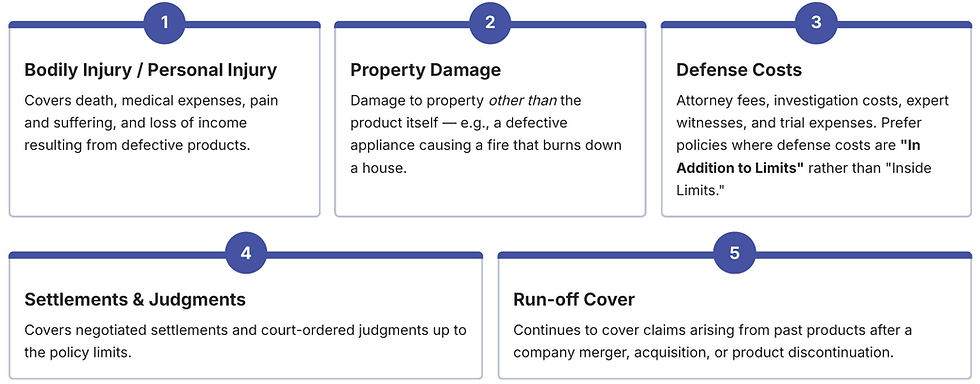
What Does Product Liability Insurance Cover?
Standard policy belongs to the Products-Completed Operations Hazard part of Commercial General Liability (CGL), or a standalone Products Liability Policy. Core coverage:
Bodily Injury / Personal Injury: Death, medical expenses, pain and suffering, loss of income.
Property Damage: Damage to property other than the product itself (e.g., defective appliance causing fire to burn down house).
Defense Costs: Attorney fees, investigation fees, trial fees (most policies are “In Addition to Limits” or “Inside Limits”, recommend the former).
Settlements & Judgments.
Run-off Cover: Continues to cover past products after company merger/acquisition.

Common Additional Coverages (Need Separate Purchase or Endorsement):
Products Recall / Product Tampering: Product recall expenses (testing, notification, recovery, destruction, reputation loss). Highly recommended! Standard policies usually do not cover recalls (CPSC mandatory recall cases frequent).
Personal & Advertising Injury: Defamation, invasion of privacy, etc.
Financial Loss Extension: Certain pure economic losses (some policies automatic from US$250,000).
Common Exclusions (Not Covered):
Known defects, intentional acts.
Contractual Liability (unless endorsement).
Recall expenses (must be purchased separately).
Punitive Damages (excluded in some policies, depending on state law).
Pollution, Asbestos related.
Foreign Products Exclusion clause — must delete this clause.

Policy Types and Key Clauses (Essential for Export to the U.S.)
Occurrence vs Claims-Made:
Occurrence (occurrence basis): Covers claims for “events occurring during the policy period”, even if claims are made years later. Strongly recommended for product liability (injuries may be latent for many years, such as medical devices).
Claims-Made (claims basis): Covers claims “made during the policy period”. Cheaper, but need to purchase Extended Reporting Period (Tail Coverage) after termination.
Territory / Jurisdiction:
Must include USA & Canada or Worldwide, and clearly “Claims brought in US courts”.
Chubb HK, Wickfield, Liberty Specialty Markets HK, QBE etc. all provide Worldwide Jurisdiction.
Additional Insured / Vendor’s Endorsement:
Must list U.S. buyers/importers/retailers as “Additional Insured”.
Vendor’s Endorsement: Protects seller even if no fault is sued. Essential for contracts, but pay attention to limit sharing and defense conflicts.
Limits of Liability:
Product Risk Level | Recommended Per Occurrence / Annual Aggregate Limit | Applicable Scenarios |
Low Risk (Clothing, Stationery) | US$1M / US$2M | Small exporters |
Medium Risk (Electronics, Home Appliances) | US$2M–5M / US$5M–10M | Amazon sellers, most consumer goods |
High Risk (Toys, Children’s Products, Medical, Chemicals) | US$5M–10M+ (can add Umbrella) | Children’s products need CPSC compliance; manufacturers/large volume exports |
Large Retailer Requirements | US$10M–25M+ | Large retailer requirements, can be increased via Umbrella/Excess Layer |

Product Liability Insurance Pricing Details and Cost Analysis
2026 product liability insurance pricing is highly customized, mainly calculated based on U.S. annual sales (US Sales), with typical rates ranging from 0.1%–1.5%+ of sales (i.e., US$1–15 per US$1,000 sales, converted to HKD depending on risk).
Marsh Asia Q4 2025 report shows: Overall Asian commercial insurance rates continue soft (down 5%), but U.S. exposed risk (US-exposed) premiums have risen 5–10% instead, mainly due to social inflation, increase in verdicts and litigation funding. Hong Kong exporters’ goods are often treated as “Asian/China manufactured”, insurance companies will add “Foreign Products Loading”, resulting in premiums 20–50% higher than pure U.S. domestic manufacturing.
Main Pricing Influencing Factors (in order of importance):
Product risk level (highest impact)
U.S. annual sales (higher sales, lower rate, but higher total premium)
Past claims record (Claims History)
Coverage limits and deductible (Limits & Deductible/SIR)
Policy form (Occurrence more expensive but more stable)
Additional coverage (Products Recall, Vendor’s Endorsement)
Compliance level (CPSC/FDA/UL test reports, supply chain audits)
Broker/underwriter choice (competitive quotes can reduce 10–25%)
2026 Reference Premium Table
Risk Level | Product Examples | U.S. Annual Sales (USD) | Annual Premium Range (HKD) | Per US$1,000 Sales Rate | Notes |
Low Risk | Clothing, stationery, non-consumer electronics | < 5 million | 5,000 – 18,000 | 0.10% – 0.35% | Easiest to obtain, Pay-As-You-Sell most cost-effective |
Low Risk | Same as above | 5 million – 20 million | 15,000 – 45,000 | 0.08% – 0.25% | Larger sales = better rates |
Medium Risk | Home appliances, consumer electronics, wireless devices | 5 million – 20 million | 25,000 – 85,000 | 0.25% – 0.80% | FCC certification can reduce 10–15% |
Medium Risk | Same as above | > 20 million | 70,000 – 150,000 | 0.20% – 0.60% | Large amounts negotiable |
High Risk | Toys, children’s products, medical devices | 3 million – 10 million | 40,000 – 120,000 | 0.50% – 1.20% | Need CPC/510(k), Recall add-on mandatory |
High Risk | Chemicals, food contact products | > 10 million | 100,000 – 300,000+ | 0.80% – 1.80%+ | May need Umbrella layer |
E-commerce Specific (Pay-As-You-Sell) | Any category | Monthly variation | Minimum HK$200/month | Real-time sales 0.15% – 1.2% | YAS/QBE, automatic deduction via Amazon/Shopify API |
Pay-As-You-Sell Model (Recommended for E-commerce): Launched by QBE + YAS in 2024, widely adopted in 2026. Premium calculated in real time based on actual U.S. monthly sales (via API integration), no need to prepay the full year, suitable for sellers with fluctuating sales. Minimum monthly fee only HK$200, no upper limit, but rates dynamically adjusted (good risks as low as 0.15%). EverBright can also connect similar customized solutions.

Practical Tips to Reduce Premiums (can reduce 15–40%):
Provide complete test reports and supply chain audits → reduce risk loading
Increase deductible to US$25,000–50,000
Three consecutive years no claims → Claims-Free Discount
Multiple brokers quote simultaneously (including EverBright actuarial model)
Purchase Occurrence + Umbrella combination
Sign Vendor’s Endorsement with U.S. buyers to share limits

How Exporters Purchase Insurance? (Practical Acquisition Methods)
Hong Kong insurance market is mature, can directly purchase US-enforceable policies (supported by U.S. insurance companies or reinsurance):
Recommended Insurance Companies/Brokers:
Chubb HK: Worldwide jurisdiction, Run-off Cover, Products Recall can be added. Suitable for design/manufacturing/export.
QBE + YAS: “Pay-As-You-Sell” product liability insurance launched in 2024, for Amazon/Shopify sellers, premium calculated based on actual sales (suitable for e-commerce).
Professional Brokers (such as EverBright): Specialized for exporters, USA & Canada coverage, premium starting US$1,500, minimum Excess US$5,000.
Liberty Specialty Markets HK: Combined General & Products Liability, automatic US exports cover.
Others: AIG, Allianz, Hang Seng Insurance, Clema Risk Solutions (focus on U.S. export risk management).
Premium Reference (2026):
SMEs low risk: HKD 5,000–20,000/year.
Medium + U.S. sales: HKD 20,000–100,000+ (calculated at 0.1–1% of U.S. annual sales).
High risk/high amount: Higher. Influencing factors: product type, U.S. sales volume, past claims record, test reports, supply chain transparency.
Application Process:
Provide business plan, product list, U.S. sales forecast, compliance certificates (CPSC/FDA test reports).
Broker quotation + U.S. lawyer review of wording.
Obtain Certificate of Insurance (COI) for U.S. buyers.
Update sales data at annual renewal.
Best Practices and Risk Management
U.S. lawyer review all contracts (Indemnity, Insurance Requirements).
Comply with U.S. standards (CPSC, ASTM, FDA, UL, etc.), retain all test/design records 5–10 years.
Establish product safety committee, customer complaint tracking system, Litigation Hold policy.
Require upstream suppliers to have insurance + Vendor’s Endorsement.
Product labels/instructions clear in English with adequate warnings.
Purchase Products Recall additional coverage.
Avoid “Foreign Products Exclusion”.
Use Occurrence policies with high limits.
Conduct regular risk audits (third-party product safety audits).
Clearly include Vendor’s Endorsement in the policy and exclude unnecessary risks.
Claims Process and Notes
Upon incident → Immediately notify insurance company (usually within 48 hours).
Provide documents: incident report, product batch number, test records, contracts.
Insurance company assigns U.S. lawyers to handle (most major insurers have US panel counsel).
Retain all records for at least 10 years after the policy period.
2026 Special Reminder: In the current U.S.-China trade environment, Hong Kong goods are often treated as Chinese goods. Insurers scrutinize “Made in China” products more strictly (may require higher premiums or additional due diligence). E-commerce sellers are strongly advised to use QBE Pay-As-You-Sell model, with premiums adjusting in real time based on sales.

Product-Specific Regulatory Requirements, Customs Requirements and PGAs
Different commodities involve different PGAs, requiring additional permits, certifications, labeling. CBP requires electronic submission of PGA Message Set in the ACE system.
Food and Agricultural Products (FDA + USDA Led)
FDA Requirements (most foods, including seafood, fruits, processed foods, dietary supplements):
Food Facility Registration: Foreign production/storage facilities must register with FDA (biennial update).
Prior Notice: Submit via FDA system at least 2 hours (air) to 5 days (sea) before goods arrive at U.S. port.
Labeling: English, Nutrition Facts, allergens, country of origin, manufacturer information. Comply with FDA 21 CFR.
Safety Standards: FSMA (Food Safety Modernization Act) requires preventive controls, supplier verification. Third-party testing may be required.
Inspection: Random or high-risk sampling at ports, violations lead to detention/refusal of entry.
USDA/APHIS/FSIS:
Meat, poultry, eggs, dairy: FSIS equivalence certification, import permits, eligible country lists.
Plants/seeds/fresh produce: APHIS Phytosanitary Certificate, Lacey Act declaration (wood packaging).
Animal products: VS Permit (Veterinary Services Permit).
Others: Alcoholic beverages require TTB labeling.
Pharmaceuticals, Medical Devices, Cosmetics, Biologics (FDA Led)
Pharmaceuticals: Require FDA approval (NDA/ANDA), facility registration, labeling compliant with 21 CFR 201. Prior Notice required for import.
Medical Devices: Classified I/II/III, require 510(k) or PMA certification, Unique Device Identifier (UDI).
Cosmetics: No pre-approval required, but must be safe with correct labeling (no medical claims). Voluntary VCRP registration.
Biologics: Regulated by CBER, require licensing.
Consumer Products, Toys, Textiles (CPSC Led)
CPSC Safety Standards: Toys require ASTM F963 testing, lead/phthalate restrictions for children’s products.
Labeling: Care Label (textiles), Tracking Label.
Children’s Products: Third-party test reports + Children’s Product Certificate (CPC).
Electronic Products and Wireless Devices (FCC Led)
FCC certification (SDoC or Certification), EMC/RF testing. Labels must contain FCC ID.
Chemicals, Pesticides, Environmental Products (EPA Led)
TSCA certification (Toxic Substances Control Act).
Pesticides require EPA registration number.
Dangerous goods: DOT 49 CFR classification, UN packaging, dangerous goods declaration.
Automobiles and Parts (EPA + NHTSA + DOT)
EPA emissions certification, NHTSA safety standards, vehicle certification.
Other Common Categories
Wood Products/Pulp: Lacey Act declaration (origin, species).
Wildlife and Plants: USFWS CITES permit.
Weapons/Dual-Use Items: ITAR/DDTC or EAR export controls (exporters must also pay attention to Hong Kong export controls).
Prohibited/Restricted Items: Counterfeits, ivory, certain food additives, unapproved drugs, etc. (CBP prohibited list).
Summary Table of Common PGAs:
FDA: Food, drugs, devices, cosmetics.
USDA/APHIS/FSIS: Agricultural and livestock products.
EPA: Chemicals, pesticides, vehicles.
CPSC: Consumer products, toys.
FCC: Electronics, wireless.
NHTSA/DOT: Vehicles, dangerous goods.
TTB: Alcohol, tobacco.
If you need sample policy wording, quotation simulations for specific product categories (such as toys, electronics, food), or a comprehensive solution combining Cargo Insurance/product liability insurance, please provide the product HS code or details. Our AI Inusrance Expert can provide you with more targeted answers.
Disclaimer: The above is compiled from publicly available information as of February 2026. Actual policies are subject to final underwriting by the insurance company. Please consult licensed professionals. Wishing you success with your U.S. export business!


Comments