Retail Store Insurance Guide: How Hong Kong Retailers Prevent Stock Loss and Customer Claims
Operating a retail store in Hong Kong—whether it is fashion, jewelry, watches, cosmetics, electronics, department stores, stationery, eyewear, or daily snacks—most owners focus on "turnover, foot traffic, and conversion rates." However, they often overlook two core risks that can cause a small shop to close or a large store's profits to evaporate:
Stock Loss: Theft, shoplifting, damage, flooding, fire, employee theft, perishability, and display damage.
Customer Claims: Slips and falls, product allergies, injuries from facilities, property damage, and legal litigation.
According to the Hong Kong Federation of Insurers' 2026 Retail Industry Risk Data:
The annual claim rate for the HK retail industry is as high as 31.2%, second only to the catering industry, making it a high-risk SME sector.
Retail stores lose 3%–8% of total inventory value annually due to theft, damage, flooding, and accidents.
The average compensation for a single customer slip, collision, or allergy claim is as high as HK$500,000 – $1,000,000.
Over 38% of HK retail stores have experienced "buying the wrong insurance, insufficient coverage, false declarations, or rejected claims."
For high-value retail (jewelry, watches, electronics, skincare), a single instance of theft or damage can easily exceed HK$1 million in losses.
Unlike the office sector, retail stores have unique risk attributes: open foot traffic, dense stock, high-intensity displays, floor wear and tear, frequent cash transactions, and high employee turnover.
For owners, HR, and administrative heads, shop insurance is not an "expense"—it is a fundamental risk tool to control inventory shrinkage, isolate litigation risks, and stabilize annual profits. Many stores appear profitable monthly, but end-of-year accounts show no gain because unmanaged stock loss and sudden third-party claims have silently eaten the profit.

I. Two Core Sources of Loss: Stock Loss + Customer Claims
1.1 Stock Loss (The most common and overlooked hidden loss)
Stock loss scenarios across different retail sectors overlap significantly and are the primary culprits for annual inventory discrepancies:
External Risks: Street shop theft, shoplifting, burglary, malicious damage by passers-by, damaged display goods.
Natural Disaster Risks: Typhoons, rainstorms/leaks, flooding, water seepage damaging packaging, oxidation due to humidity.
Accidental Equipment Risks: Air conditioner leaks, falling lights, shelf collapses, shattered glass cabinets, electrical short circuits causing smoke damage.
Internal Management Risks: Employee theft, internal-external collusion, inventory discrepancies, cash shortages, damage during restocking.
Inventory Attribute Risks: Cosmetics spoiling due to moisture, expired snacks, scratched electronics, stained apparel, damaged luxury items that cannot be sold.
Key Point: Most stock losses are "fragmented, long-term, and cumulative." Individual amounts may be small, but the annual total is extremely high and often cannot be written off, directly compressing net profit.
1.2 Customer Claim Risks (The fatal risk that can bankrupt a store instantly)
Hong Kong is a high-compensation and high-litigation environment. If a customer is injured or their property is damaged, they are highly likely to appoint a lawyer to seek compensation.
Slipping or tripping over wet floors or cluttered aisles causing fractures or sprains.
Shelves, displays, lightboxes, or hanging decorations falling and injuring customers.
Shattered glass or mirrors cutting customers.
Skincare, cosmetics, or perfumes causing skin allergies, swelling, or damage claims.
Sharp edges or defects in accessories, toys, or daily necessities causing injury.
Water leaks or falling items damaging a customer's phone, handbag, or luxury goods.
Claims for pain, suffering, and loss of earnings due to long-term injury.
Accidental damage to the landlord's building, renovations, or facilities, leading to recovery claims from the landlord.
A single serious claim can easily reach several hundred thousand to over a million HKD, far exceeding a small shop's annual profit.

II. Six Essential Insurances for HK Retail Stores (HR/Owner Professional Configuration)
2.1 Employees' Compensation Insurance (Labor Insurance | The Only Legal Mandate)
If you have full-time, part-time, substitute, temporary sales staff, or warehouse staff, you must insure by law. There are no exemptions. Failure to provide Labor Insurance is illegal (max fine HK$100,000), and the owner bears unlimited personal liability for work injuries.
Coverage: Medical expenses, sick leave compensation, disability, and death benefits for injuries sustained during work (e.g., slips, sprains while moving goods, cuts from glass).
Key Tip: All part-time and weekend temp staff must be declared; failure to report leads to rejected claims.
2.2 Shop Comprehensive Property Insurance (Targeting "Stock Loss")
This is the most practical and cost-effective insurance for retail, covering all accidental losses of hardware, inventory, and equipment.
Insured Items: Renovations, shelves, lighting, window glass, POS systems, electronics, air conditioners, display equipment, all stock for sale, and packaging.
Scenarios: Fire, explosion, typhoon, rainstorm, flood, lightning, external burglary, theft, malicious damage, and accidental breakage.
Essential Add-ons: All-risks for glass, signage/lightbox coverage, and moisture/water damage.
2.3 Public Liability Insurance (PL | The Shield Against Million-Dollar Claims)
While Labor Insurance covers staff, PL covers customers, passers-by, and third parties. Most shopping mall leases and brand partnerships strictly require a valid PL policy.
Core Coverage: Compensation, legal fees, and settlement costs for customer injuries (slips, falls, hits) or property damage within the shop.
2.4 Product Liability Insurance (Product Safety Protection)
Many owners mistakenly believe PL covers "injuries caused by products." PL covers the premises, while Product Liability covers the goods you sell.
Applicable Industries: Cosmetics, skincare, jewelry, toys, snacks, baby products, electronics.
Scenarios: Allergies from skincare, injuries from sharp toy edges, hidden defects causing property damage, or food poisoning from retail snacks.
2.5 Money Insurance (Cash Theft and Robbery)
Covers robbery, theft of cash in the shop, losses during transit to the bank, and counterfeit money losses. Essential for high-cash-flow businesses like street shops or jewelry stores.
2.6 Business Interruption Insurance (Protecting Cash Flow During Closure)
If a shop must close due to a fire or flood, revenue stops but rent, wages, and management fees continue. This covers the loss of gross profit and fixed expenses during the closure period.

III. 2026 HK Retail Insurance Premium Logic (HR/Owner Insight)
3.1 Risk Levels (Determines Base Premium)
Low Risk: Stationery, bookstores, apparel, leather goods, general department stores.
Medium Risk: Cosmetics, eyewear, sports goods, electronic accessories, snacks.
High Risk: Mobile phones/digital, jewelry/watches, high-value luxury goods.
3.2 Five Core Pricing Factors
Premises Type: Street shops (Higher risk, no 24h management) > Mall shops (Lower risk, CCTV, security). Street shops are usually 10%–15% more expensive.
Size & Stock Value: Larger areas and higher inventory values lead to higher premiums.
Headcount: Labor insurance is calculated per capita.
Operating Hours: Longer hours/weekends slightly increase risk/premium.
NCB (No Claim Bonus): Claims-free years earn discounts; a claim can hike premiums by 20%–40% the following year.

IV. 8 Legal Cost-Saving Tips for Retail
Bundle Policies: Buying Labor + Property + PL + Product Liability from one insurer can trigger discounts of 25%–32%.
Protect your NCB: For minor losses under HK$10,000, consider self-funding repairs to avoid losing the 35% annual discount.
Accurate Declaration: Ensure you aren't misclassified as a higher-risk category (e.g., a boutique being classified as high-risk electronics).
Raise the Deductible: Choosing a deductible (Excess) of HK$5,000–$10,000 can reduce premiums by 10%–18%.
Safety Records: Maintain floor cleaning logs and CCTV maintenance records to negotiate a 5%–15% risk management discount.
Real Inventory Valuation: Insure for the average stock value to avoid overpaying or being penalized for under-insurance.
Optimize Facilities: Installing anti-theft gates and non-slip mats can downgrade your risk rating.
Tax Deduction: Insurance premiums are fully tax-deductible as business operating costs.

V. 2026 Golden Insurance Plans (Sample Quotes)
5.1 Basic Shop (Under 10 staff, <500 sq ft, Low-cost goods)
Coverage: EC (100M), PL (20M), Property (1M) + Glass/Signage.
Annual Premium: HK$18,000 – $30,000.
5.2 Standard Shop (10–20 staff, Mall-based, Cosmetics/Electronics/Snacks)
Coverage: EC (100M), PL (30M), Product Liability (30M), Property (2-3M) + Moisture/Glass, Money (100k).
Annual Premium: HK$35,000 – $60,000.
5.3 High-Value Retail (Jewelry/Watches/Luxury/Digital Chains)
Coverage: EC (100M), PL (50M), Product Liability (50M), Property (5M-10M) + All-risk Theft, High-limit Money + Business Interruption.
Annual Premium: HK$80,000 – $150,000.
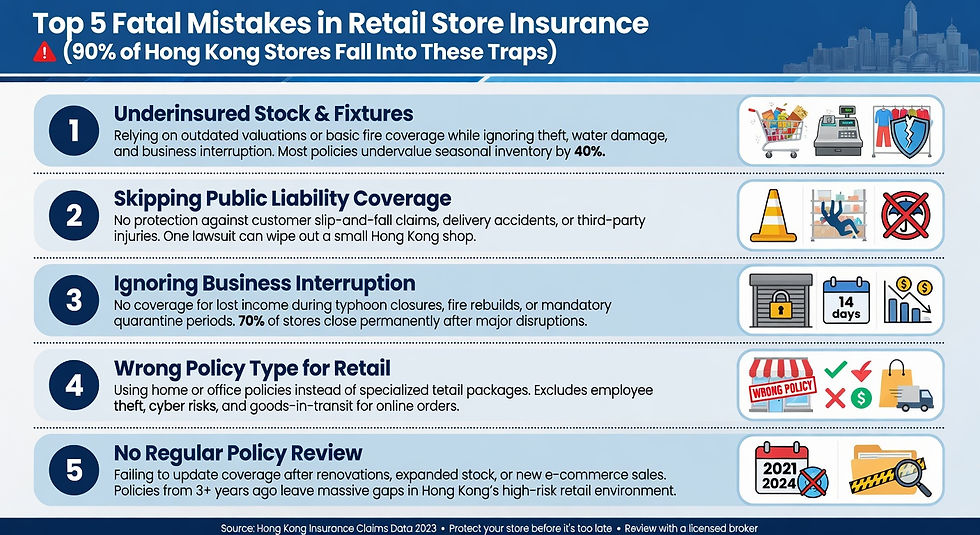
VI. Five Fatal Pitfalls in Retail Insurance
Only buying Labor Insurance: Ignoring PL and Property risks.
Confusing PL with Product Liability: Mistakenly thinking PL covers product-related injuries.
Careless Declaration: Paying "lazy taxes" due to incorrect risk classification.
Claiming for Small Amounts: Destroying the NCB discount for minor claims.
Ignoring Add-ons: Skipping glass, signage, and moisture coverage—the most frequent loss types.

VII. Conclusion
In the competitive HK retail market, profit logic is about controlling controllable risks. While owners focus on turnover, they must also shield their profits from stock loss and customer claims. Insurance is the most cost-effective risk isolation tool. In 2026, retail success depends not just on sales ability, but on risk management capability.


Comments